logo
Über uns

Shenzhen Rona Intelligent Technology Co., Ltd

weitere informationen
bitte um ein angebot
Unternehmen.img.alt
Unternehmen.img.alt
Unternehmen.img.alt
Warum?
Wählen Sie uns
picurl
Hohe Qualität
Vertrauenssiegel, Bonitätsprüfung, RoSH und Beurteilung der Lieferfähigkeit. Das Unternehmen verfügt über ein strenges Qualitätskontrollsystem und ein professionelles Testlabor.
picurl
Entwicklung
Internes professionelles Designteam und Werkstatt für fortgeschrittene Maschinen. Wir können zusammenarbeiten, um die Produkte zu entwickeln, die Sie brauchen.
picurl
Herstellung
Fortgeschrittene automatische Maschinen, streng verfahrenskontrollierendes System. Wir können alle elektrischen Endgeräte herstellen, die Sie brauchen.
picurl
100% Dienstleistung
Großhandels- und kundenspezifische kleine Verpackungen, FOB, CIF, DDU und DDP. Lassen Sie uns Ihnen helfen, die beste Lösung für all Ihre Sorgen zu finden.
Lösung
Lösung
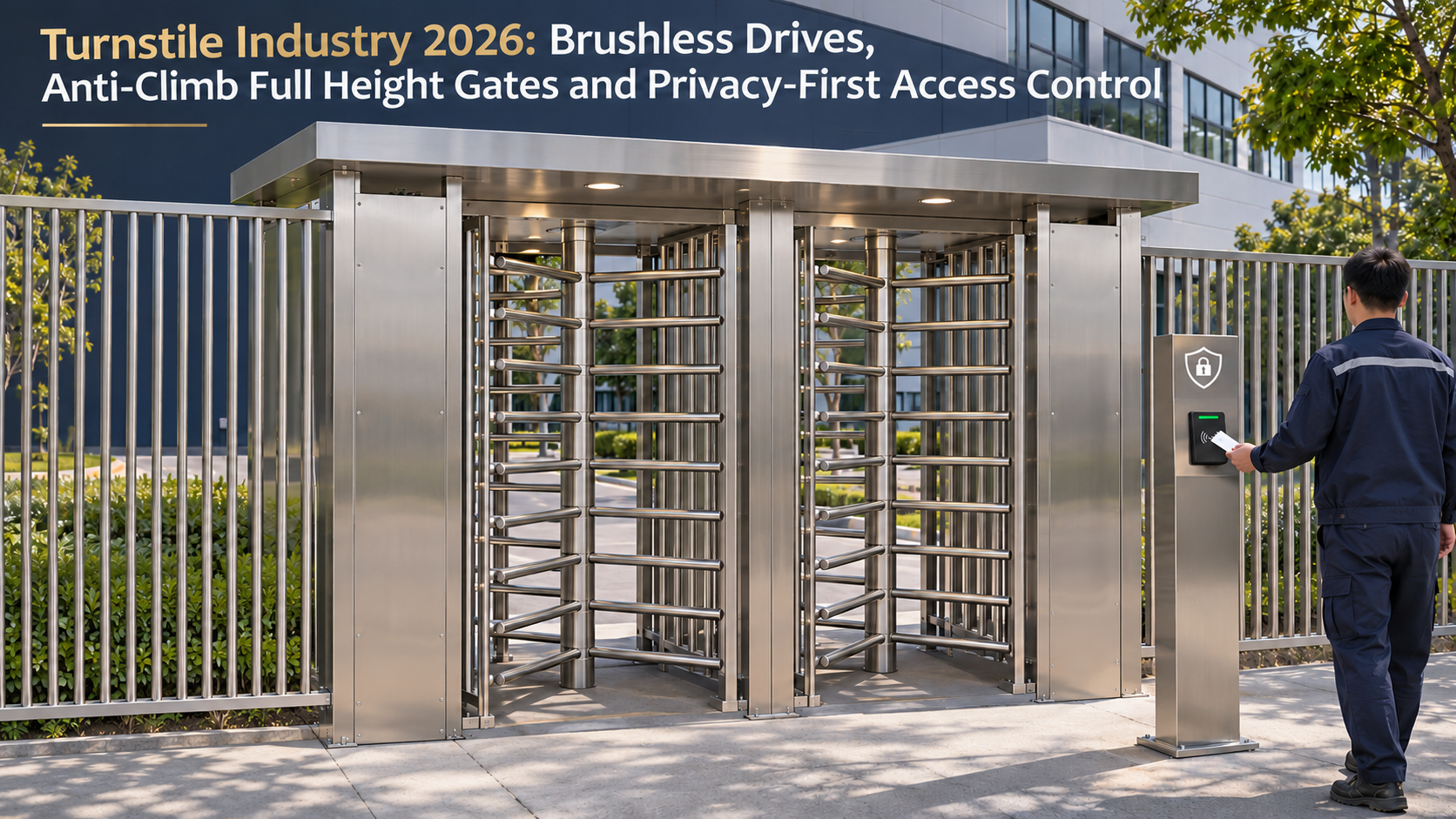
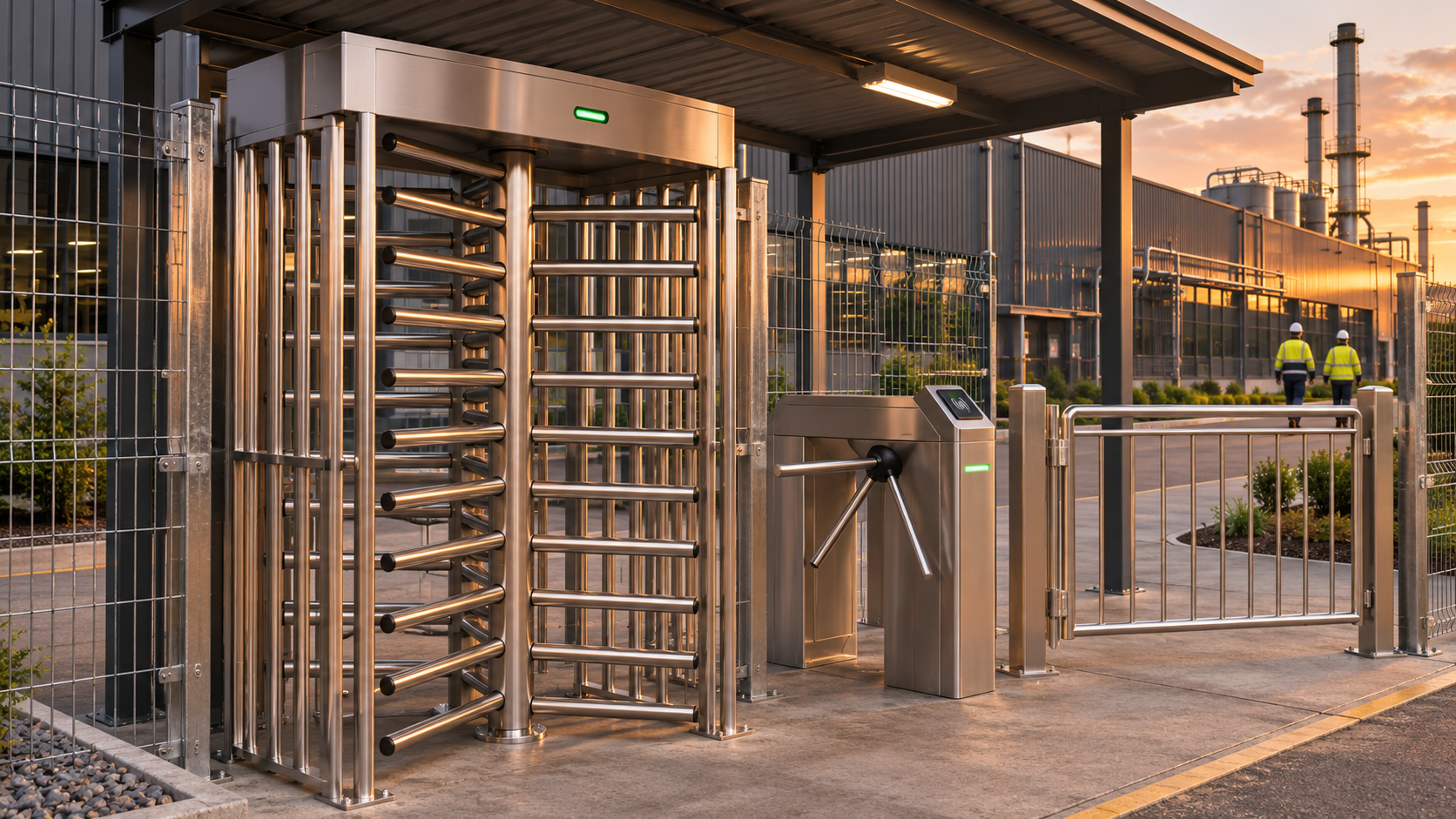
  • North China Factory Installs Semi-Automatic Full Height Turnstiles with Anti-Climb Anti-Tailgating Design
    11-16 2026
    A manufacturing plant in northern China needed to lock down its perimeter pedestrian access against intrusion, climbing and tailgating — without posting a guard at every gate. The plant installed semi-automatic full height turnstiles at its main staff entrance and its restricted workshop corridor. Years into service the units run continuously with no recorded failure. Customer Background Location: Northern China — cold winters, dust, wide seasonal temperature swing Sector: Manufacturing / industrial plant Access points: Main staff entrance and a restricted workshop corridor Security requirement: Anti-climb, high-security pedestrian control, strict anti-tailgating Operating pattern: Two shift changes per day, plus contractor and visitor traffic The Security Problem The plant sits on an open industrial estate where perimeter fencing alone was not enough. Three risks drove the specification: Climbing and vaulting. Waist-high flap or tripod barriers can be stepped over in seconds; the plant needed a barrier tall enough that climbing is impractical. Tailgating and piggybacking. Two people passing on one authorised card was routine at shift change — and unacceptable to an auditor. Reverse rotation. Once inside the rotor, arms could be pushed backwards to let a second person slip through. Delivered Solution and Technical Specification Parameter Specification Security Benefit Product type Semi-automatic full height turnstile Full-height cage enclosure blocks climbing and vaulting Dimensions L2400 × W1350 × H2200 mm 2200 mm overall height leaves no handhold or foothold for an intruder Rotor configuration 120° rotor, three-arm One person per 120° rotation — the chamber admits a single body at a time Anti-reverse function 60° anti-reverse lock Arms cannot be pushed backwards mid-transit; removes the piggyback route Tailgating control Single-entry chamber logic Each authorised card yields exactly one rotation, one person Mechanism Yellow galvanised movement assembly Zinc coating resists corrosion and abrasion in dust-heavy conditions Operation mode Semi-automatic (manual push, damped return) No motor wear from constant cycling; safe for high-volume shift traffic Service record 5–8 years, no failure reported Verified by customer after multi-year field operation Why Semi-Automatic Full Height Was the Right Choice Motorised full height units are fast, but the motor is the part most exposed to wear at two heavy shift changes a day, and a dead gate at shift handover is an operational crisis. A semi-automatic unit removes the risk: the user pushes the rotor through and a damped mechanism returns it home. No drive motor cycling hundreds of times daily, no controller to fail, and no power failure that can trap someone in the chamber. How the Anti-Climb and Anti-Tailgating Design Works Anti-climb. At 2200 mm high with enclosed side panels and a 1350 mm wide cage, the structure presents no grip point. The rotor arms sit well above waist height, so nobody can lever over the top or squeeze between arms and frame. 120° rotor, one person per rotation. The three-arm rotor divides the chamber into three 120° sectors. Pushing through advances exactly one sector — the geometry itself enforces single-person entry, independent of software. 60° anti-reverse lock. Once the rotor moves 60° past home, a mechanical lock engages and the arms cannot be driven backwards. A tailgater following a cardholder has no route through; the second person is physically excluded. Durability in a Northern China Climate Sub-zero winters, wind-blown grit and heavy summer dust are hard on outdoor hardware. The galvanised yellow mechanism was chosen for exactly that: the zinc layer sacrifices itself before the base steel, so rotor bearing surfaces and locking pawls stay free of rust and abrasion. With a semi-automatic architecture the number of wearing components is small — hence 5–8 years of failure-free duty on the original mechanism. Results and Client Feedback At the main entrance the new full height turnstiles restored a one-card-one-person rule at peak shift change without adding guard headcount. The workshop corridor is now genuinely restricted: no climbing route exists, and the 60° anti-reverse lock closed the piggyback gap the audit team had flagged. The maintenance log shows no failures across 5–8 years of service. Conclusion This northern China factory project shows why the full height turnstile remains the reference solution wherever genuine anti-climb and anti-tailgating performance is required. A 2200 mm enclosure, a 120° single-person rotor, a 60° anti-reverse lock and a wear-resistant galvanised mechanism work together as a mechanical guarantee, and semi-automatic operation takes the motor out of the reliability equation entirely.
  • Guangdong University Deploys Brushless Flap Barrier Turnstiles for High-Throughput Campus Access Control
    11-16 2026
    In a public university in Guangdong Province, China, the campus management team replaced the ageing entry gates at three high-traffic pedestrian points — the main library entrance, the teaching-building lobby and the dormitory zone — with a bank of brushless flap barrier turnstiles. The campus accommodates more than 20,000 students and staff, and the previous gates simply could not absorb the 7:40–8:20 morning peak. After a competitive tender, the university selected a brushless, economically priced flap barrier configuration that delivered measurable throughput gains without exceeding the capital budget. Customer Background Location: Guangdong Province, China (humid subtropical climate, high pedestrian volume) Sector: Higher education — public university campus Population served: 20,000+ students, faculty and campus staff Access points upgraded: Library entrance, teaching-building lobby, dormitory zone Access credential: Campus smart card / QR code / face recognition integration Challenges the University Faced Queue build-up at peak hours. Legacy swing gates allowed roughly 15–18 persons per minute; queues backed up 40–60 metres into the campus plaza every morning. High maintenance cost. Brushed motors required frequent brush replacement in the humid Guangdong climate, generating recurring labour and downtime. Safety concerns. Students walking with umbrellas, laptops and backpacks frequently struck the moving wings; the old units had no effective rebound protection. Budget discipline. As a public institution, the university required an economical solution with a low total cost of ownership across a five-year service life. Tight installation window. The works had to be completed during the eight-week summer break. Delivered Solution and Technical Specification The selected model is a single-lane brushless flap barrier turnstile with transparent acrylic wings, supplied in the compact footprint shown below. Parameter Specification Project Benefit Dimensions L1500 × W280 × H990 mm Compact 280 mm cabinet width preserves corridor space while the 1500 mm length houses a full-length wing travel Drive system Brushless DC motor No carbon brush wear, maintenance-free operation, lower noise and far longer service life Control board Brushless motor controller board Accurate position feedback, smooth acceleration ramp, self-diagnostics on start-up Barrier wings Transparent acrylic Full visibility for security staff, modern appearance, impact-resistant and easy to clean Throughput 25–30 persons per minute Roughly 60% higher peak flow than the replaced gates Collision protection Mechanical anti-collision + force-resistance anti-collision (dual protection) Wings absorb and rebound on impact; motor torque limits before injury or damage occurs Positioning Economical high-volume configuration Best cost-per-lane ratio in the tender evaluation Performance Data After Handover Metric Before Upgrade After Upgrade Verified throughput per lane 15–18 persons/min 25–30 persons/min Morning-peak queue length 40–60 m Under 10 m Motor brush maintenance Every 6 months None required (brushless) Wing-impact incidents reported Recurring weekly Zero injury reports in first semester Installation duration — Completed within the 8-week summer break How the Dual Anti-Collision Design Works in Practice Two independent layers protect students at the gate line: Mechanical anti-collision. The acrylic wing is mounted on a sprung clutch. When a student brushes or strikes the wing, the wing physically gives way instead of stopping dead, then returns to its home position automatically. No motor stall, no broken wing. Force-resistance anti-collision. The brushless controller continuously monitors motor current. If resistance exceeds the configured threshold — for example a person leaning on the wing — the drive instantly reverses and releases, limiting the applied force well below the level that could cause injury. For a campus where students walk shoulder-to-shoulder with umbrellas, trolley bags and bicycles at the same time, this combination proved to be the decisive factor in the tender scoring. Why the Brushless Configuration Was Chosen Guangdong's humid, salt-laden air is notoriously hard on brushed motors: carbon brushes wear quickly and commutators corrode. By moving to a brushless motor and brushless control board, the university removed the single largest recurring maintenance item from its five-year budget. In parallel, the brushless drive runs quieter — an important point for the library entrance — and delivers more consistent torque across the full wing cycle, which is exactly what sustained 25–30 persons per minute demands. Results and Client Feedback Across the first full semester of operation, the three upgraded access points handled the morning peak without a single queue extending beyond the entrance plaza. Campus security reported zero wing-impact injuries, and the facilities team confirmed no motor maintenance was required. The university's project lead summarised the outcome simply: the gates are economical, durable and fast — precisely the three priorities set at the start of the tender. Conclusion This Guangdong university project demonstrates that a well-specified, economically positioned brushless flap barrier turnstile can deliver enterprise-grade reliability on a public-institution budget. Compact dimensions, transparent acrylic wings, verified throughput of 25–30 persons per minute and layered mechanical plus force-resistance anti-collision protection together form a repeatable blueprint for campus, factory and office-park access control projects worldwide.
  • Büro-Lobby-Schwingtür-Gehäuse: Bürstenlose Tore mit 8-Paar-IR und Gesichts- + QR-Zugang
    09-16 2026
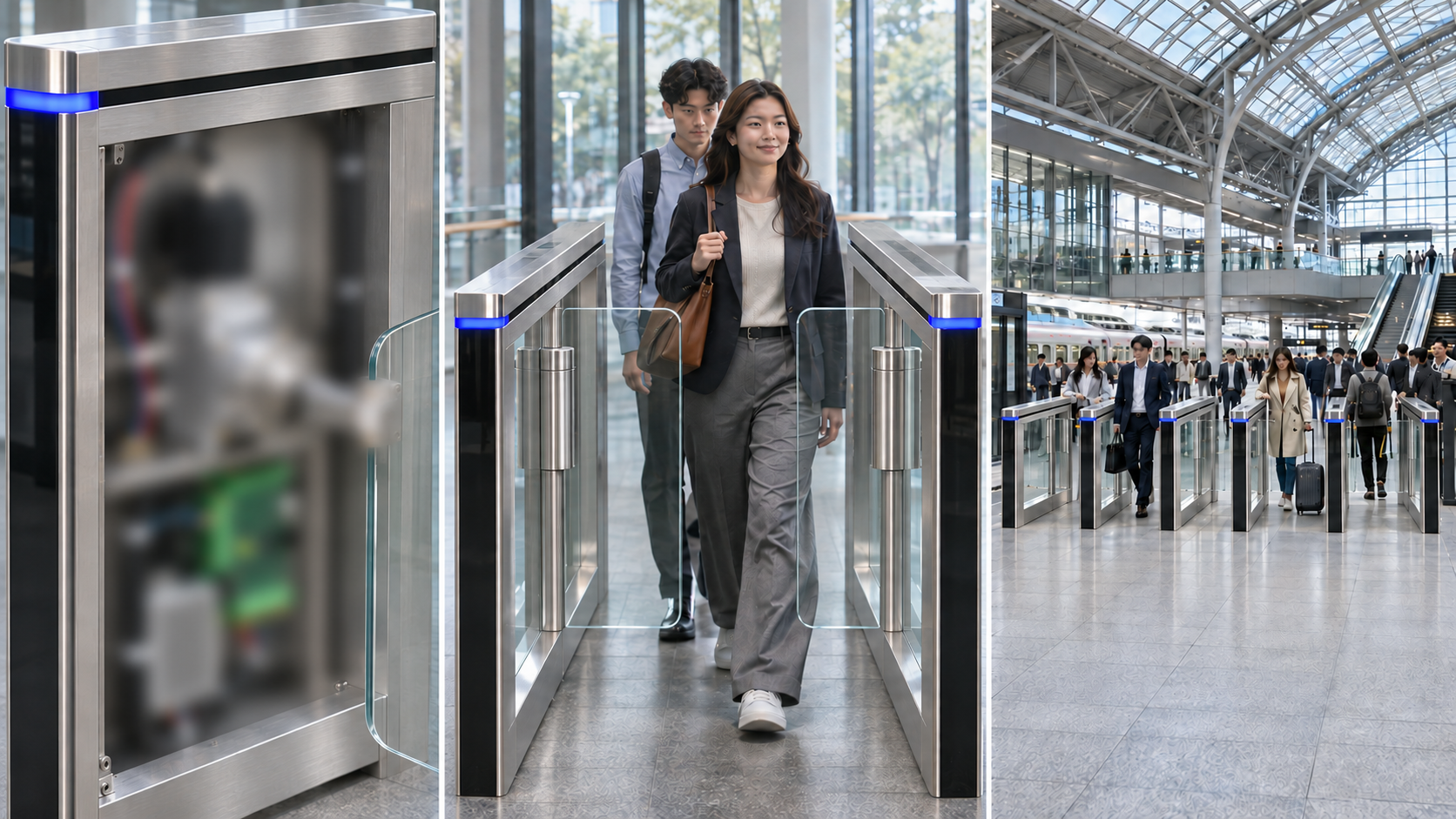
    Eine Eingangshalle eines Bürogebäudes ist einer der sichtbarsten und sich am schnellsten bewegenden Eingänge in jeder Gewerbeimmobilie. Sie muss einen hohen täglichen Personenfluss von Mitarbeitern und Besuchern bewältigen, elegant genug aussehen, um zur Marke des Gebäudes zu passen, und gleichzeitig unbefugten Zutritt verhindern. Dieser Fallbericht beschreibt ein Zugangsprojekt für eine Eingangshalle, das auf bürstenlosen Schwingtüren mit 8-paariger Infrarotdetektion und kombinierter Gesichts- und QR-Code-Erkennung basiert. Projektübersicht Der Standort war die Haupteingangshalle eines modernen Bürogebäudes. Das Management benötigte eine Zugangslösung, die sich in ein sauberes, zeitgemäßes Interieur einfügt und gleichzeitig den Spitzenverkehr während der Stoßzeiten bewältigt. Die wichtigsten Anforderungen waren klar: Ein elegantes, minimalistisches Erscheinungsbild, das zum Design der Eingangshalle passt Schneller, zuverlässiger Durchgang für Mitarbeiter während der Stoßzeiten Zwei Zugangsmethoden: Gesichtserkennung und QR-Code Genaue Erkennung von Personen, die sich unbefugt durchschleichen, um unbefugten Zutritt zu verhindern Geringe Geräuschentwicklung und lange Lebensdauer für den kontinuierlichen täglichen Betrieb Die Lösung: Bürstenlose Schwingtüren Die gewählte Konfiguration war eine Reihe von bürstenlosen Schwingtüren, die am Eingang der Eingangshalle installiert wurden. Schwingtüren bieten einen breiten, natürlichen Durchgang, der für Büroumgebungen geeignet ist, während der bürstenlose Motor in einer ganztägig betriebenen Eingangshalle echte Vorteile bringt: reibungsloserer und leiserer Betrieb, geringerer mechanischer Verschleiß, höhere Energieeffizienz und reduzierter Wartungsaufwand über die Lebensdauer des Produkts. Das schlanke, stromlinienförmige Gehäuse und die saubere Oberfläche des Tors liefern genau das einfache, elegante Aussehen, das der Kunde wünschte. 8-paarige Infrarotdetektion Jede Spur war mit 8 Paaren von Infrarotsensoren ausgestattet. Ein dichtes Infrarot-Array verbessert die Erkennungsgenauigkeit dramatisch: Es unterscheidet eine Person von einer Tasche oder einem Trolley, verfolgt die Bewegungsrichtung und verhindert das Durchschleichen – eine kritische Sicherheitsfunktion in einer Büroeingangshalle, in der sich Mitarbeiter und Besucher nebeneinander bewegen. Diese dichte Sensorik macht das Tor auch schneller und sicherer zu durchqueren, da sich die Türen für einen legitimen Benutzer während der Durchfahrt nicht schließen. Gesichts- und QR-Code-Zugang Die Zugangsebene kombinierte Gesichts-Erkennungs-Terminals mit QR-Code-Lesern und gab dem Gebäude zwei komplementäre Zugangsmethoden. Mitarbeiter können freihändig mit Gesichtserkennung eintreten, während Besucher, Auftragnehmer und Zeitarbeitskräfte QR-Codes verwenden, die über das Besuchermanagementsystem ausgestellt werden. Die Kombination sorgt für ein bequemes Erlebnis für Stammkunden und eine kontrollierte Abwicklung für Gäste, ohne ein separates Tor oder eine manuelle Kontrollstelle hinzuzufügen. Zusammenfassung der Produktkonfiguration Artikel Spezifikation Produkttyp Bürstenlose Schwingtür Anwendung Haupteingangshalle eines Bürogebäudes Infrarotdetektion 8 Paare pro Spur Zugangsmethoden Gesichtserkennung + QR-Code Oberfläche Einfaches, elegantes Design Schlüsselfunktionen Anti-Tailgating, Kollisionsschutz, geräuschloser Betrieb Ergebnisse und Vorteile Reibungsloser Durchsatz während der Stoßzeiten mit freihändiger Gesichtserkennung Flexible Besucherverwaltung über QR-Codes Zuverlässiger Schutz vor Durchschleichen dank 8-paariger Infrarotsensorik Leise, wartungsarme bürstenlose Motoren für den ganztägigen Betrieb Ein sauberer, moderner Eingang, der das Markenimage des Gebäudes ergänzt Schlussfolgerung Für Eingangshallen von Bürogebäuden muss die richtige Zugangslösung ein Gleichgewicht zwischen Aussehen, Geschwindigkeit, Sicherheit und Zuverlässigkeit herstellen. Durch die Kombination von bürstenlosen Schwingtüren, 8-paariger Infrarotdetektion und Gesichts- + QR-Zugang bietet dieses Projekt einen Eingang, der elegant aussieht, mühelos zu bedienen und sicher im Design ist – eine praktische Referenz für ähnliche gewerbliche Eingangsprojekte.
Jüngste Blogs
Entdecken Sie die neuesten Blogs
Kontakt mit uns
Ermittlung
Wenn Sie Fragen haben, kontaktieren Sie uns bitte sofort und wir werden so schnell wie möglich antworten.
Sie können uns auch auf sozialen Medien folgen.
008613554907786